By Kristen Curry
Summer arrives in Roger Williams Park and hidden parts of the park emerge: the roses bloom and the train launches its merry ride around the carousel. The swan boats emerge from their winter hibernation.
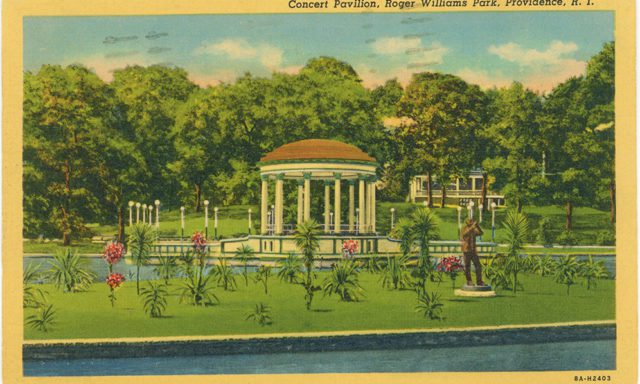
One part of the park being revealed this summer is the “hidden” archives in the Museum of Natural History. To help celebrate the park’s 150th birthday, Museum Director Renée Gamba has curated a new exhibit of historic photos, postcards, maps, artwork, etc. of the park. “Treasures from the Archives” opened in early July and will be on display through the end of 2022. A dedicated corps of volunteer docents helped curate the new exhibit.
Up on the third floor, the climate-controlled archives is a cool place to visit on a hot summer day. With 250,000 objects in the museum’s collection, most is in storage vaults at any given time, with only 1% of the collection on display, as is typical of most museums. Meticulous files stack the walls of the room.
This out-of-sight space contains vital records of early park history.
The only natural history museum in the state, the museum’s collection started with John Steere, who donated 900 mammals and birds from his collection to the city of Providence, a common activity of the time. Early park leaders were initially undecided if the museum should be dedicated to art or natural history but settled on natural history with the building of the RISD Museum around that time and hired its first director. Founded during the Victorian period, city residents were excited to bring the world to Providence. The museum became the People’s University and over the years has offered extracurricular education to thousands since its opening in 1896.
The museum includes the only public planetarium in the state, the 2,000+ Manly Hardy Bird Collection, holdings from Oceania, all of the North American bears on display, and exhibits on urban wildlife, the International Space Station, the museum’s Victorian past, and the Earth through time.
The archive docents employ modern archival techniques to navigate the museums’ treasures. Student interns from the Met School have also gotten a view into the park’s past, glimpsing Horace Cleveland’s original park plans and other unique pieces of Providence history such as Betsey Williams’ bible and will.
The new lobby exhibit includes postcards, posters, maps and letters from the early years of the park, which today is managed and operated by the City of Providence Parks Department.

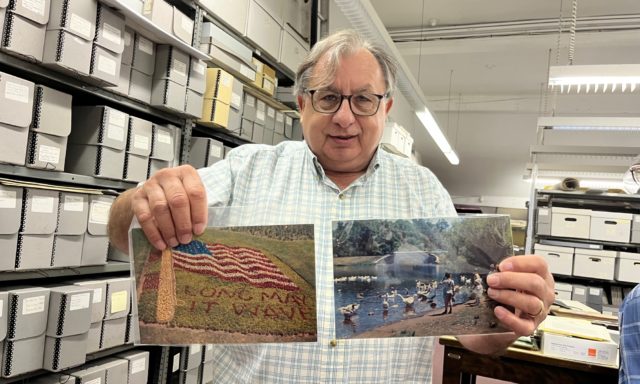
L-R: Docents Mike McGinity, Richard Siembab, and Bill La Civita with Museum of Natural History Director Renée Gamba.
Richard Siembab, the veteran of the docent volunteers, leads the park’s cemetery tour and has been working in the archives for ten years now. “I love to organize things, put things in order,” he says. “It’s a labor of love.”
The team has made some great discoveries – “aha moments” – including a letter from Admiral Peary, offering a polar bear from the North Pole for the city’s collection (the price was too high and the deal went untaken). Boxes and documents date to the 1800s, filled with beautiful handwriting. A magic lantern viewer illuminates snapshots of the day. Over the years, order has been restored to what was once a catchall space, a grandmother’s attic for the city at large.
Docent Bill La Civita says the museum’s day-to-day correspondence offers vivid glimpses into life a century ago. A lifelong reader, Bill is interested in finding undiscovered mysteries. He focused on the postcards, now on display. “Each is a moment in history,” he says. When not in the museum correspondence files, Bill leads tours of the botanical and rose gardens. He next plans to tackle the museum guest books, to see if anyone famous visited a century ago.
Docent Mike McGinity grew up visiting the museum regularly. He has launched a number of docent-led programs, including the RWP Statuary Stroll, Motoring through the Monuments, the Guido Nincheri lecture, Top to Bottom Archives, and the Lost Park tour, coming up on August 28.
At a few hours a week in total, these projects will take a lot of time; new volunteers are always welcome. Another generation is needed as volunteers, they say, and the benefits are worthwhile: “The work is so interesting. One thing leads to another.”
“This museum is an incredible collection,” Mike says. “People should be proud of this place, not just Providence, but the whole state.”
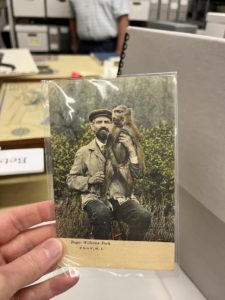
Historic postcard showing animal handler with monkey from “Monkey Island”
Today, Renée continues to look outward from the museum. “How we’ve grown through time is exciting to see; we always want to extend the museum walls,” she comments. “The museum has always been for the people. We’re not just a building with old stuff, but a snapshot of the city, of life in Rhode Island over the years.”
This spring the park commemorated its long history with the burying of a time capsule underneath the bronze dog in the Zoo; while that sits underground to be opened in the distant future, the museum is a time capsule open every day. Stop by.
The exhibit opened on July 5, and is viewable daily during museum hours through September (9:30-3:30). Visit https://www.providenceri.gov/museum/ for details. Roger Williams Park and the Museum of Natural History are managed by the Providence Parks Department.